

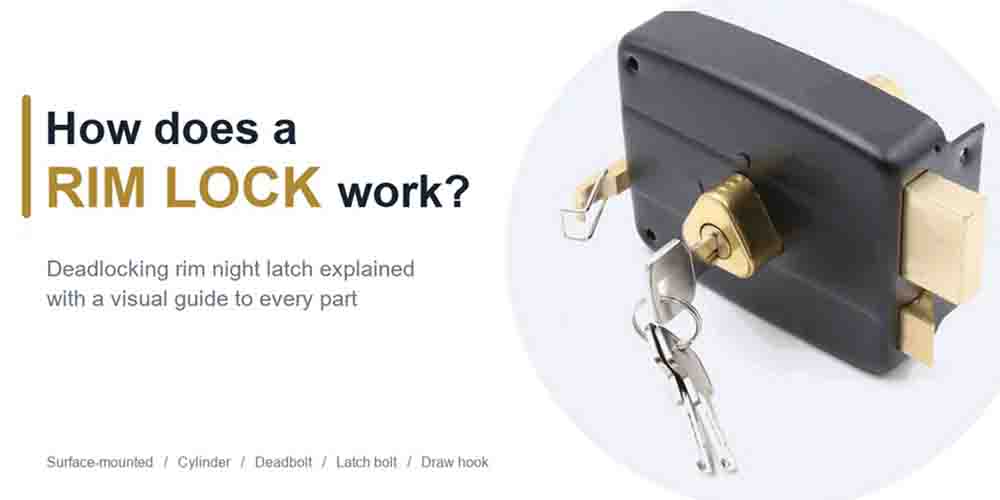
A rim lock works when a key turns the cylinder, rotating a flat metal tailpiece behind it. That tailpiece drives a cam inside the lock case, which throws the latch bolt or deadbolt into a strike plate fixed to the door frame.Therefore, when installing it, you only need to cut a slot for the lock cylinder.
Components Related To a Deadlocking Rim Night Latch Lock
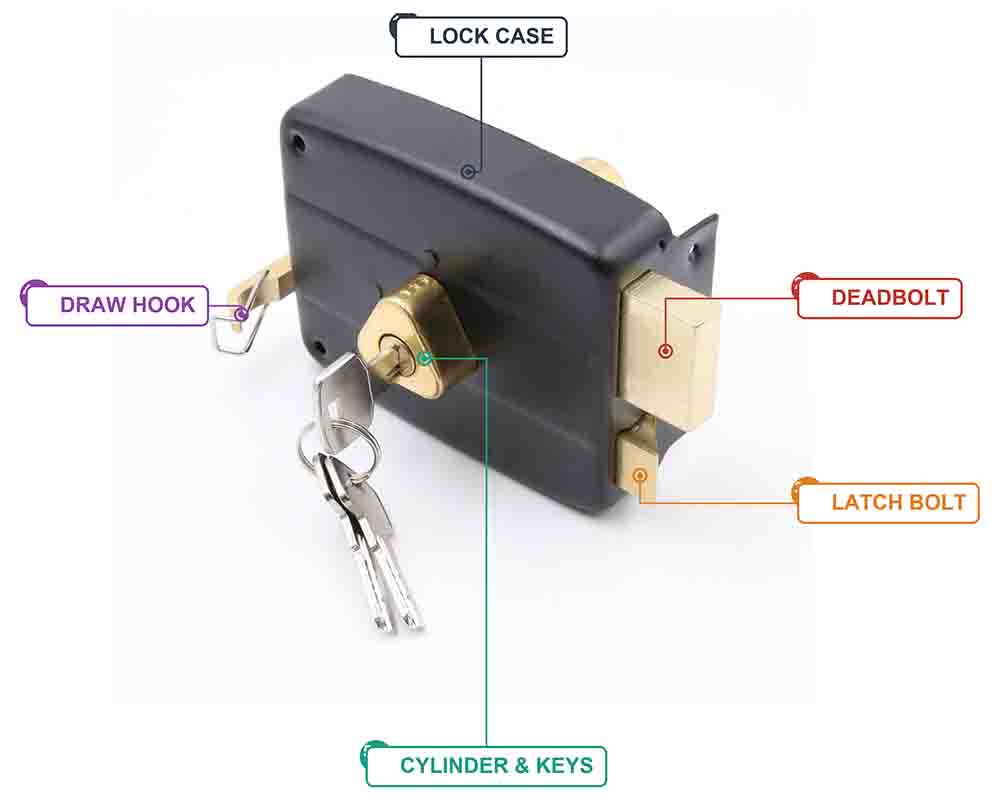
The maximum security provided by a deadlocking rim night latch depends on the following components: deadbolt, latch, draw hook, cylinder, and key.
How Does a Rim Lock Work?:
- Use Key Turns the Rim Cylinder: The cylinder is the part you see on the outside(long/short tapered end). Turning the key causes the internal cam lever to rotate.
- The Tailpiece Moves the Linkage: On a night latch, it lifts a set of levers connected to the bolt. On a deadlocking rim lock, it drives a cam that throws a solid deadbolt.
- The Latch Bolt Enters the Striker: A striker on the frame catches it. Clean alignment here is what stops the door from rattling or failing to latch.
- The Spring Pulls the Latch Back: Turn the key in the opposite direction, or use the internal draw hook, and the spring will retract the latch bolt from the strike plate on the door frame.
- Use the Snib (Draw Hook) to Keep the Door Closed. : Most rim locks have a small thumbpiece. Slide it and the latch stays retracted, so the door closes without locking.
Animated Demonstration for Rim Lock
A mechanical door lock has no complex wiring inside, and there is no need to install a hidden lock body inside the door; this is why rim locks are suitable for surface mounting.
Rim lock VS Mortise Lock: Which One Should You Buy?
| Rim lock | Mortise lock | |
| Install | Door Surface | Grooving on the Inner Side of the Door |
| Security | Low | Higher |
| Strength | Solid | Higher |
| Position | Exposed | Internal |
| Application | Entrance Doors, Courtyard Gates | Front Doors, Commercial Entries |
| Direction | Left-opening, Right-opening | Universal |
To a certain extent, I can’t guarantee which type of lock is the best for you. In my opinion, neither of these two types of locks has any absolute advantages or disadvantages.
The main advantages of a rim lock are that it’s easy to install and convenient to maintain and clean; however, a mortise lock requires a slot to be cut into the door for the lock body to be inserted, and its internal structure is more complex. If you need to replace a faulty mortise lock, the process can be difficult, so the installation dimensions must be marked accurately—otherwise, you’ll end up spending more money and time on it.
However, a mortise lock offers higher security for exterior doors; a rim lock provides less security than a mortise lock.
How Much Does a Rim Lock Cost?
The exact cost of a rim lock depends on its material, size, surface finish, number of keys, key material, MOQ,packaging (prices vary between color boxes and white boxes), and security certifications. If you’d like to get a quote quickly, please provide the detailed specifications listed above; manufacturers will be able to provide a quote much faster than if you only provide a single image.
Before Purchasing Rim Locks in Bulk, You Should Keep the Following in Mind:
- Wrong Direction: When replacing an old lock, left-hand and right-hand locks are not interchangeable (except for ambidextrous models). The specifications must match those of the existing lock.
- Wrong Backset: 60 mm and 70 mm are the common backset distance. Before ordering, please accurately measure the distance from the edge of the door to the center of the lock cylinder.
- A Striker is Not Aligned: If the strike plate does not align with the latch, the square bolt and the beveled bolt will not fully engage with the strike plate.
- Provide detailed requirements: If you wish to obtain price quotes from rim lock manufacturers more quickly, you should provide specific requirement parameters—such as minimum order quantity (MOQ), material, number of keys, surface finish, and dimensions. The final price of a rim lock is primarily determined by these factors.
Frequently Asked Questions
1.Are rim locks secure?
A basic rim lock does not offer the highest level of security; it should be used in conjunction with other security devices, such as chains or bolts.
2.Can I fit one myself?
Yes, an externally mounted mechanical rim lock requires a hole for the cylinder, some mounting screws, and a striker plate. You can complete the installation using only a power drill, a screwdriver, a tape measure, and a pencil.
3.Is a rim lock the same as a night latch?
In everyday UK usage, often yes. Strictly, a night latch is a rim-mounted door lock that features a locking bolt (latch bolt).
4.What is a tailpiece?
The flat bar on the back of the cylinder that turns with the key. It is the physical link between the key and the bolt mechanism.